
Supported out-of-tree modules
A CGRAN-like directory of the GNU Radio out-of-tree modules you can use in GNU Radio World. Each entry is researched from the project repository and links to every matching flowgraph in our example library.
-
gr-satellites
gr-satellites is a broad collection of telemetry receivers for amateur satellites and other spacecraft that use publicly documented downlinks. Its reusable demodulators, synchronizers, forward-error-correction stages, descramblers, and deframers cover protocols including AX.25, GOMspace modems, CCSDS links, AO-40, and numerous mission-specific formats. Complete satellite definitions combine those components to turn IQ or audio into frames, human-readable telemetry, and reassembled files such as transmitted images, while the lower-level pieces can also serve new ground-station designs.
- Main author
- Daniel Estévez
- Last modified
- < 3 months
-
gr-ais
gr-ais receives the Automatic Identification System, the 9600 bit/s GMSK transponder bursts ships and shore stations exchange on the two maritime VHF channels at 161.975 and 162.025 MHz. Its streaming receiver centers a channel with a square-and-FFT frequency estimator, levels it with a feedforward AGC, recovers symbol timing with a generalized-MSK timing error detector, and demodulates coherently with a Viterbi decoder whose trellis carries the carrier phase as part of its state; a data-aided burst synchronizer offers a second path that detects each isolated burst against the known training sequence and seeds that decoder with its timing, phase and trellis state. Differential decoding and inversion undo the NRZI line code, GNU Radio's HDLC deframer unstuffs the bits and checks each packet's CRC, and a PDU-to-NMEA block turns the payloads into the !AIVDM sentences chart plotters and AIS aggregators read. An ais_rx command-line tool wires the chain to a SoapySDR device, a raw I/Q file or a UDP stream and prints the decoded sentences.
- Main author
- Nick Foster
- Last modified
- < 3 months
-
gr-bbc
gr-bbc implements the Baird, Bahn, and Collins concurrent-code technique for communication through asymmetric interference and intentional jamming. Its encoder maps each message prefix to pseudorandom marks in a much larger codeword, while its decoder searches only branches whose required marks remain present in the received word. Because interference may add marks without erasing existing ones, independently encoded messages can be combined with a bitwise OR and recovered concurrently, and the module pairs this codec with on-off-keying blocks for a complete baseband link.
- Main authors
- James Morrison, Neil Rogers
- Last modified
- < 3 months
-
gr-ieee802-11
gr-ieee802-11 is a software-defined IEEE 802.11a, 802.11g, and 802.11p transceiver for simulation and over-the-air experimentation. Its transmit path builds MAC frames and OFDM physical-layer waveforms, while its receiver detects frames, synchronizes frequency and timing, estimates the channel, equalizes subcarriers, and decodes packet data. The module can interoperate with ordinary Wi-Fi hardware and vehicular-network prototypes, and it connects decoded frames to network stacks and packet-analysis tools through message interfaces.
- Main author
- Bastian Bloessl
- Last modified
- 2026-05-19
-
gr-adsb
gr-adsb is a receiver and decoder for Automatic Dependent Surveillance-Broadcast and related Mode S replies. Its signal-processing chain detects 1090 MHz pulse-position-modulated transmissions, recovers framed messages, verifies or repairs their parity, and turns their fields into aircraft state. The decoder covers identification, altitude, velocity, position, and several surveillance reply formats, with compact or detailed textual output and interfaces for forwarding decoded traffic to other applications.
- Main author
- Matt Hostetter
- Last modified
- 2026-04-09
-
gr-radar
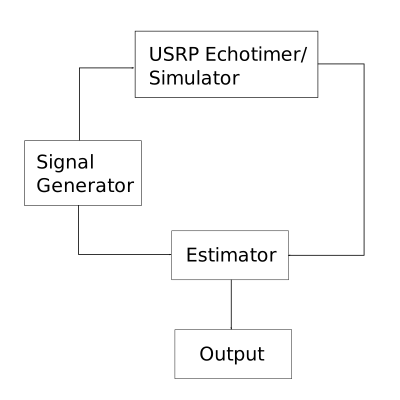
gr-radar is a modular toolbox for constructing and evaluating software-defined radar systems in GNU Radio. It provides waveform generators and estimators for continuous-wave, frequency-modulated continuous-wave, frequency-shift-keyed, pulsed, and OFDM radar, together with target simulation, echo timing, matrix processing, detection, and tracking components. These pieces form complete ranging, velocity, cross-section, and target-tracking pipelines that can operate in simulation or with synchronized radio hardware and can feed plotting and result-reporting interfaces.
- Main author
- Stefan Wunsch
- Last modified
- 2026-03-12
-
gr-lora_sdr
gr-lora_sdr is a complete software-defined implementation of the LoRa physical layer, built for both controlled experiments and communication with commercial radios. The transmitter assembles headers and checksums, whitens and error-corrects payloads, interleaves and maps their bits, and produces chirp-spread-spectrum symbols with configurable LoRa parameters. The receiver performs packet synchronization, sample- and carrier-offset correction, soft demodulation, deinterleaving, decoding, dewhitening, and integrity checks, enabling end-to-end links even at very low signal-to-noise ratios.
- Main author
- Joachim Tapparel
- Last modified
- 2026-01-05
-
gr-rds
gr-rds implements the Radio Data System and Traffic Message Channel carried on the 57 kHz subcarrier of FM broadcasts. Its receive chain synchronizes and decodes RDS groups, checks their block structure, parses station and program metadata, and presents information such as the program identifier, service name, radio text, clock time, and alternative frequencies. Complementary encoder and tagging components can construct RDS groups and insert them into an FM multiplex, making the module useful for both broadcast reception and transmitter experiments.
- Main authors
- Dimitrios Symeonidis, Bastian Bloessl
- Last modified
- 2026-01-04
-
gr-dvbs2rx
gr-dvbs2rx supplies the bit-interleaved coded-modulation decoding stages used by DVB-S2 and DVB-T2 receivers. Its blocks convert soft constellation decisions into deinterleaved codewords, perform low-density parity-check decoding, and apply the outer BCH correction needed to recover protected payload bits. The module is designed as the forward-error-correction core of a larger receiver rather than a complete tuner and synchronization chain, and it supports the standard frame structures and code configurations used by those broadcast systems.
- Main authors
- Ron Economos, Ahmet Inan
- Last modified
- 2025-08-26
-
gr-dvbs2
gr-dvbs2 provides a software-defined transmitter for the DVB-S2 and DVB-S2X satellite broadcasting standards, with particular support for variable and adaptive coding and modulation. Its processing chain turns transport or generic streams into baseband frames, applies scrambling, BCH and LDPC forward-error correction, interleaving, constellation mapping, and physical-layer framing, then produces a transmit-ready waveform. It supports normal and short frames, multiple stream modes, dummy-frame insertion, and a broad selection of QPSK, 8PSK, 16APSK, and 32APSK modulation and code-rate combinations.
- Main author
- Ron Economos
- Last modified
- 2025-08-26
-
gr-paint
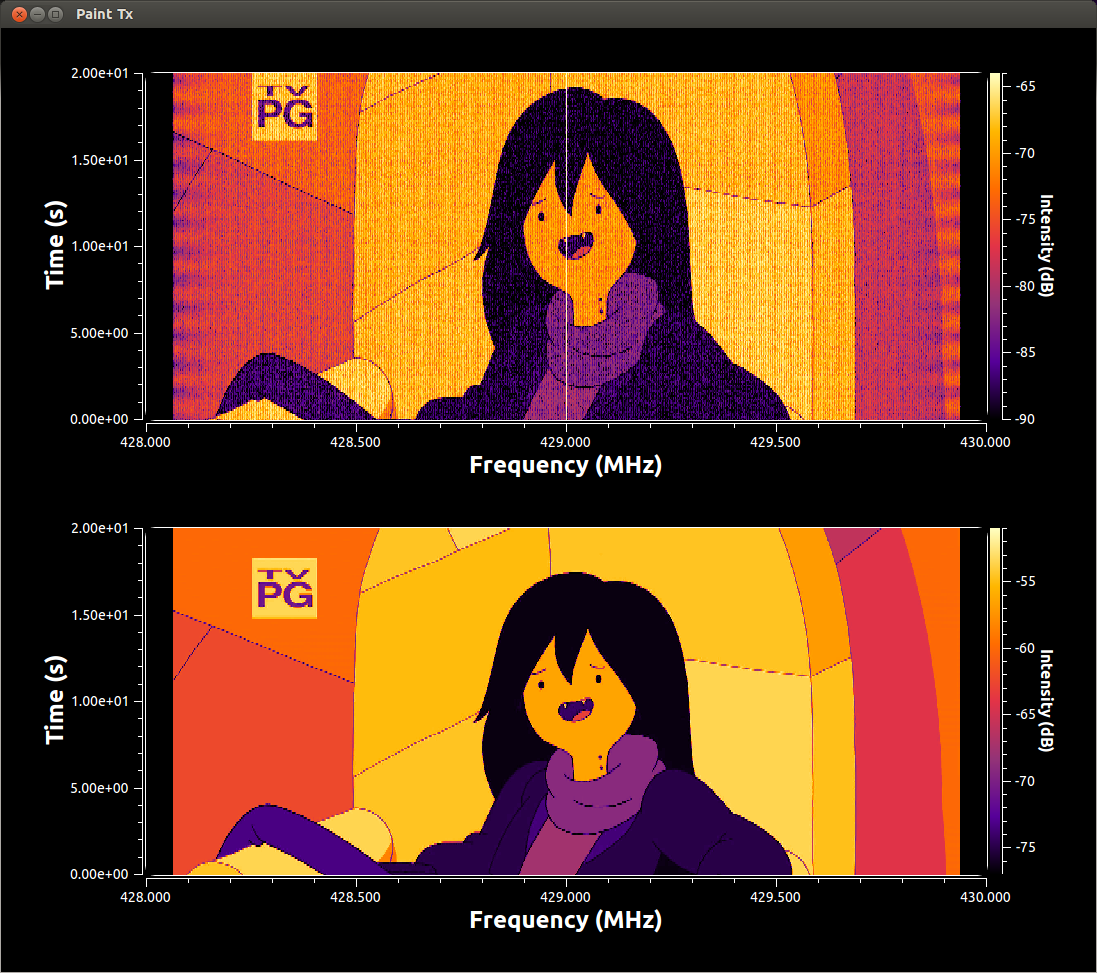
gr-paint is an OFDM transmitter that encodes monochrome images as visible shapes in a spectrum waterfall. It converts image rows into the frequency-bin magnitudes of a large inverse FFT, then repeats and cyclically prefixes the resulting time-domain lines to control their persistence and aspect ratio on a receiver display. An accompanying image source accepts common image formats, allowing arbitrary artwork, text, and test patterns to become transmit-ready IQ rather than requiring manually prepared raw luminance files.
- Main author
- Ron Economos
- Last modified
- 2025-08-24
-
gr-iridium
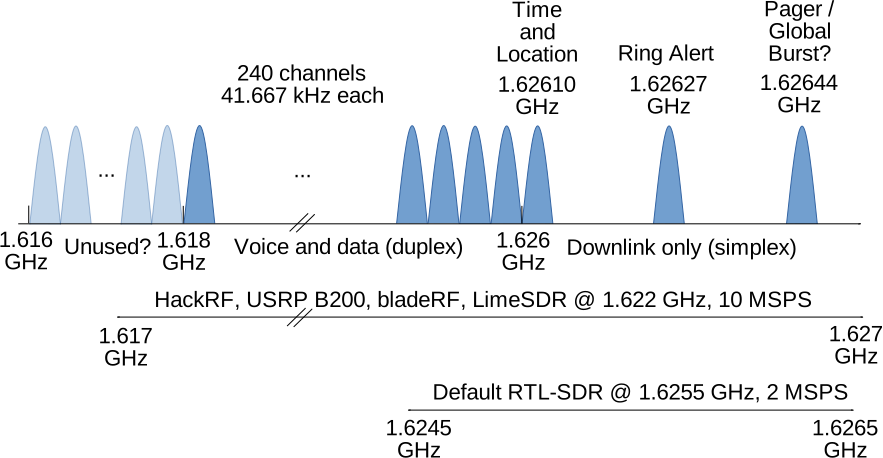
gr-iridium detects and demodulates bursts from the Iridium satellite network. Its FFT burst tagger and channelizer locate activity across a wideband capture, while tagged-burst conversion and downmixing isolate each transmission at a demodulation-friendly sample rate. A QPSK demodulator, frame sorter, and frame printer turn those bursts into timestamped raw bit frames for downstream parsing with iridium-toolkit.
- Main authors
- Tobias Schneider, Stefan Zehl
- Last modified
- 2025-03-29
-
gr-gsm
gr-gsm is a toolkit for receiving, inspecting, and processing transmissions from second-generation GSM cellular networks. Its flowgraph components synchronize to GSM bursts, separate logical channels, decode signaling and traffic data, follow frequency-hopping assignments, and represent captured bursts in reusable message and file formats. Command-line applications and transceiver interfaces build on those components to scan cells, monitor control channels, analyze protocol traffic, and exchange GSM bursts with other Osmocom software.
- Main authors
- Piotr Krysik, Vadim Yanitskiy
- Last modified
- 2025-03-10
-
gr-inspector
gr-inspector is a signal-analysis toolbox for finding and characterizing unknown activity in wideband complex sample streams. Its energy detector builds an RF map of occupied regions, and its separator shifts and filters every detected region before an extractor turns a selected message-bundled signal back into a conventional stream at an optional fixed sample rate. For OFDM signals, a parameter estimator searches likely FFT and cyclic-prefix lengths, while a companion synchronizer corrects fine frequency offset and tags the estimated symbol boundaries for downstream processing.
- Main author
- Sebastian Müller
- Last modified
- 2025-03-03
-
gr-tempest
gr-tempest is a GNU Radio implementation of Van Eck phreaking, the reconstruction of display content from unintended electromagnetic emissions produced by video cables and electronics. Its synchronization and resampling stages estimate or apply the horizontal and vertical timing of VGA and HDMI signals, correct sampling error, align the raster, and turn the recovered intensity stream back into an image. The module supports recorded captures, simulations, and live radio input, with manual, semi-automatic, and experimental automatic workflows for finding stable video geometry under noisy reception conditions.
- Main authors
- Federico Larroca, Felipe Carrau
- Last modified
- 2025-02-10
-
gr-foo
gr-foo is a collection of packet, burst, and message utilities created to support experimental wireless flowgraphs that do not belong to one protocol-specific module. Its blocks can mark and pad finite transmissions, schedule timed bursts, drop messages for loss testing, and bridge packet data to tools that understand PCAP and radiotap formats. Together these pieces provide the glue between protocol implementations, half-duplex radio hardware, automated experiments, and external analyzers such as Wireshark.
- Main author
- Bastian Bloessl
- Last modified
- 2025-01-30
-
gr-droneid
gr-droneid is an experimental receiver for the proprietary DJI DroneID signal transmitted by compatible aircraft. It detects the periodic wideband OFDM bursts, uses their Zadoff-Chu structure for timing and channel estimation, corrects carrier and phase errors, and extracts the occupied subcarriers. The remaining chain descrambles and turbo-decodes the payload before parsing DroneID fields, providing a research platform for studying DJI identification transmissions from recorded or live IQ data.
- Main author
- David Protzman
- Last modified
- 2024-05-27
-
gr-fosphor
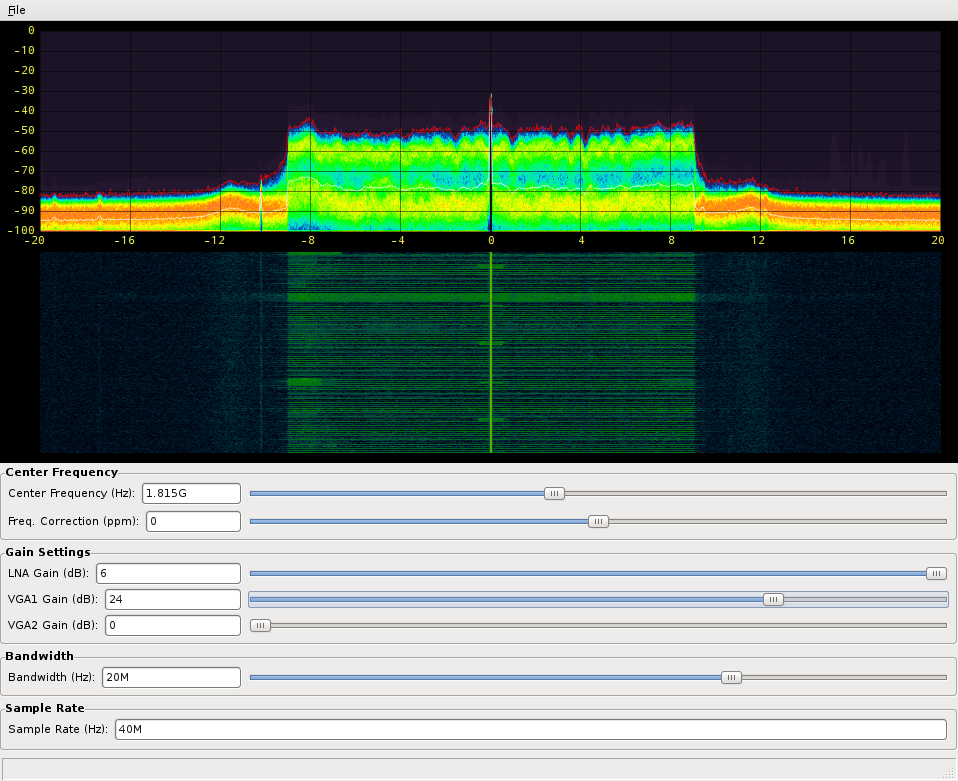
gr-fosphor is a real-time spectrum-analysis display for GNU Radio designed to reveal short-lived and overlapping RF activity. It combines accelerated FFT processing with a persistent density histogram, waterfall history, live spectrum trace, and maximum-hold trace in one continuously updating view. The OpenCL and OpenGL implementation moves the demanding spectral computation and rendering onto the GPU, allowing high-rate sample streams to be explored interactively.
- Main author
- Sylvain Munaut
- Last modified
- 2024-03-23
-
gr-ham
gr-ham collects signal-processing components useful to amateur-radio operators and experimenters. Its varicode encoder and decoder provide the variable-length character coding used by PSK31, while its CHU decoder extracts the time and status information broadcast by Canada's shortwave time service. The module also contains an incomplete D-STAR receive chain, making the project a mixture of practical narrowband utilities and exploratory digital-voice work.
- Main author
- Clayton Smith
- Last modified
- 2024-01-30
-
gr-ieee802-15-4
gr-ieee802-15-4 implements low-rate wireless personal-area networking for GNU Radio, centered on the physical layer used by Zigbee and sensor networks. It combines O-QPSK and chirp-spread-spectrum modulation chains with packet framing, burst control, and a lightweight Rime networking stack so complete radio links can be assembled from application data down to samples. The module supports interaction with Contiki and TelosB devices and can forward decoded IEEE 802.15.4 or Rime packets to sockets and Wireshark for application development and protocol analysis.
- Main authors
- Bastian Bloessl, Thomas Schmid
- Last modified
- 2023-07-28
-
gr-correctiq
gr-correctiq removes the fixed DC component that produces a spike at the center frequency of direct-conversion SDR receivers. Its continuously adapting corrector follows the mean I and Q values with a lightweight IIR estimator, while an automatic variant learns the offset for a chosen interval and then freezes it so subsequent signal content is not filtered; frequency or receiver-gain changes trigger a fresh learning pass. A manual corrector applies user-supplied I and Q offsets, and a companion SwapIQ block exchanges the components of complex, interleaved-short, or interleaved-byte streams to repair spectral inversion.
- Main author
- ghostop14
- Last modified
- 2022-07-28
-
gr-hrpt
gr-hrpt provides a modernized collection of blocks for receiving High Resolution Picture Transmission downlinks from weather and Earth-observation satellites. Its processing chains perform carrier and clock recovery, frame synchronization, deframing, and decoding so raw RF recordings can be converted into the structured data carried by NOAA, Meteor, MetOp, and related spacecraft. The resulting streams are intended for image and instrument-data software, connecting an SDR front end to the specialized tools that turn HRPT telemetry into usable satellite products.
- Main author
- Aang23
- Last modified
- 2020-06-03
-
gr-lte
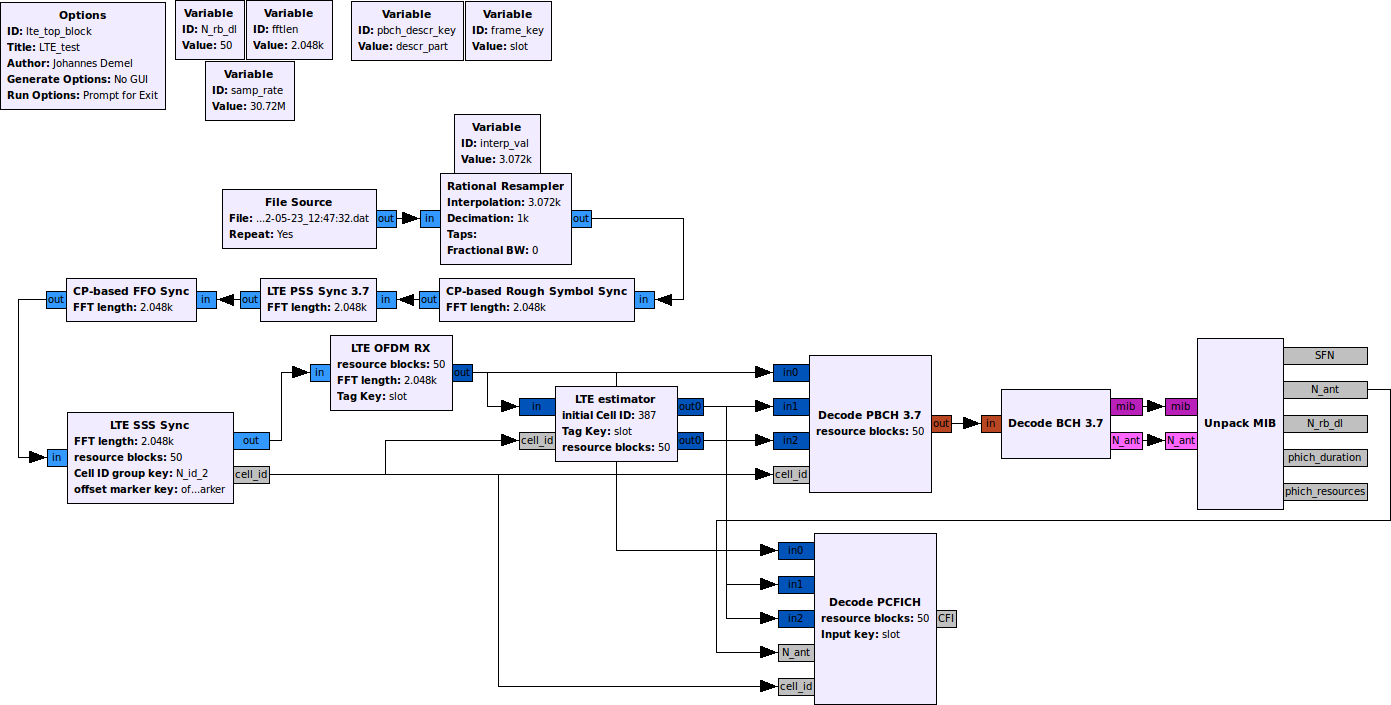
gr-lte is a modular GNU Radio receiver for the LTE downlink, designed so synchronization, OFDM processing, channel estimation, and physical-channel decoding can be studied or replaced independently. Its synchronization paths use cyclic-prefix correlation and the LTE primary and secondary synchronization sequences to establish OFDM symbol and half-frame timing, carrier alignment, and the physical-layer cell identity. Downstream blocks extract occupied subcarriers, estimate the channel, separate antenna layers, and implement the PBCH and PCFICH processing needed to recover broadcast system information from a captured cell.
- Main authors
- Johannes Demel, Kristian Maier
- Last modified
- 2018-02-20






Get your OOT added
To get your OOT added to GNU Radio World (e.g. usable blocks and example flowgraphs) and included on this list, email Marc or hop on the GNU Radio World Discord.